When you buy through links on our articles, Future and its syndication partners may earn a commission.

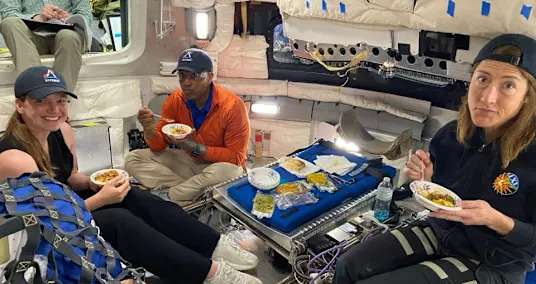
How do you eat on the way to the moon, in a spacecraft that doesn't have a fridge or a stove?
The Artemis 2 crew will demonstrate just that when they launch on their historic moon mission no earlier than April 1. The four astronauts — NASA's Reid Wiseman, Victor Glover and Christina Koch, along with the Canadian Space Agency's Jeremy Hansen — will bring along food that can be stored safely for weeks in their Orion spacecraft, then prepared quickly.
"Food selections are developed in coordination with space food experts and the crew to balance calorie needs, hydration, and nutrient intake while accommodating individual crew preferences," NASA officials wrote in a March 3 statement about the Artemis 2 menu.

Additionally, the foods must produce few crumbs and be easy to prepare in microgravity. "The crew uses Orion's potable water dispenser to rehydrate foods and beverages and a compact, briefcase-style food warmer to heat meals as needed," NASA added.
While the moon crew has a packed schedule testing Orion and performing lunar observations, meal time will be allocated for breakfast, lunch and dinner. Aside from the food, the astronauts can have up to "two flavored beverages" a day, which could include coffee for the ones used to a caffeine fix.
Food science has advanced considerably since the last Apollo astronauts flew to the moon in 1972. The space shuttle program in particular allowed for bigger menus and more onboard preparation capabilities, NASA officials said.
But any Artemis 2 astronauts hoping for something similar to the International Space Station's (ISS) menu had to reset their expectations, because the orbiting lab features refrigeration. In addition, the orbiting lab is in low Earth orbit, within easy reach of cargo ships ferrying fruit, vegetables and other perishables. No freighters will meet up with Artemis 2 in deep space, however.
As a result, "Artemis 2 uses a fixed, pre-selected menu designed for a self-contained space vehicle with no resupply," NASA officials said. However, the astronauts had ample time to weigh in on their preferred meals. "Crew members sample, evaluate and rate all foods on the standard menu during preflight testing, and their preferences are balanced with nutritional requirements and what Orion can accommodate."

NASA offered some flexibility in packing. Each Artemis 2 container has about two to three days' worth of food, allowing astronauts to pick from a few options during the mission while only opening one box. There will be some limitations depending on what Orion is doing, however.
"Menus are tailored based on the spacecraft's food preparation capabilities during each phase of flight," NASA officials stated. "Certain foods — such as freeze-dried meals — require hydration using Orion's potable water dispenser, which is not available during some phases, including launch and landing. As a result, foods selected for those phases must be ready-to-eat and compatible with the spacecraft's operational constraints, while a broader range of food options are available once full food preparation systems are up and running."
A NASA infographic provides some details about the Artemis 2 menu. For example, there are 189 unique food or drink items flying on the mission, including more than 10 types of beverage. There are five different hot sauces, 58 tortillas and a variety of sweet treats, from pudding and cobbler to cake, chocolate and cookies.

Flying on Orion is a bit like camping from a dining perspective: The spacecraft is an environment where foods must be simple to store and prepare, eating requires a minimum of fuss, and preparation is done using simple ingredients and processes.
Two of the Artemis 2 crewmates said in a NASA video that they are encouraged by the food selection. Koch, who spent about a year aboard the ISS, said she is impressed by the variety: "Different entrees that you wouldn't imagine could be rehydrated, and actually good in space, are completely fair game."
Hansen added that mealtimes are a great opportunity for the crew to come together as a community. He's looking forward to enjoying "that necessary thing you have to do, the thing that you should be grateful for" because sharing mealtimes with his friends and family "has always been meaningful for me."
latest_posts
- 1
 Bomb blast in packed Nigerian mosque kills five
 - 2German foreign minister heads to China to talk rare-earth exports
- 3CDC advisory panel delays vote on hepatitis B vaccines after unruly meeting
- 4Climate change is straining Alaska's Arctic. A new mining road may push the region past the brink
- 5SpaceX's 1st 'Version 3' Super Heavy Starship booster buckles under pressure during initial tests


- Iran-backed militias reassert power in Iraq, proving the Islamic axis is still standing
- What Yogurt Types Do You Know
- Figure out How to Streamline Eco-friendliness in Your Volvo XC40
- U.K. blocks Kanye West from entering Britain to headline now canceled festival: What led to the ban
- Blood pressure drug recalled for possible cross-contamination
- German Easter peace marches draw tens of thousands
- The Craft of Computerized Detox: Individual Trials
- Moon-bound Artemis II astronauts enjoy a relaxed day in space
- Understanding climate change in America: Skepticism, dogmatism and personal experience