When you buy through links on our articles, Future and its syndication partners may earn a commission.

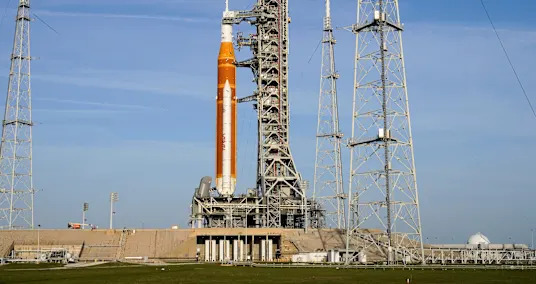
We now know how far the Artemis 2 astronauts will get from Earth — and that distance will be unprecedented.
The Artemis 2 crew — NASA's Reid Wiseman, Victor Glover and Christina Koch and Canadian astronaut Jeremy Hansen — will travel a maximum of 252,757 miles (406,773 kilometers) from their home planet, NASA announced today (April 3).
The current human-distance record, set in April 1970 by the three astronauts of NASA's Apollo 13 mission, is 248,655 miles (400,171 km).
Artemis 2 will set the new mark on Monday (April 6), when its Orion capsule loops around the far side of the moon and starts heading back to Earth.
The mission was always expected to break Apollo 13's record. But the new distance estimate — which was revealed by Judd Freiling, the Artemis 2 ascent flight director, during a press briefing this afternoon — carries more weight than previous ones did.
That's because it was calculated after Orion's translunar injection (TLI) burn, a nearly six-minute-long maneuver that sent the capsule out of Earth orbit and on its way to the moon. Orion aced the TLI on Thursday evening (April 2), charting the course for the rest of the mission — and giving NASA some real numbers to crunch.
"The translunar injection burn is the last major engine firing of the mission," NASA officials wrote in the Artemis 2 press kit.
"It propels Orion on a path toward the moon and sets it on the free-return trajectory that will ultimately bring crew back to Earth for splashdown," they added. "Though only two days into the mission, it essentially doubles as Orion's deorbit burn as well."
As those words indicate, Artemis 2 will not land on the moon, or even enter lunar orbit. It was designed from the start as a flyby mission, which aims to show that Orion is capable of carrying astronauts to and from the moon. If all goes to plan, more ambitious Artemis flights will follow, including the program's first crewed lunar landing with Artemis 4 in late 2028.
Apollo 13, by contrast, was supposed to touch down on the moon. However, an oxygen-tank explosion 56 hours after launch scotched those plans and put the mission into survival mode.
And survive it did, thanks to the ingenuity and perseverance of the Apollo 13 astronauts — commander Jim Lovell, lunar module pilot Fred Haise and command module pilot Jack Swigert — and the folks in Mission Control. Lovell, Haise and Swigert made it back to Earth safely after swinging around the moon, etching their names into the history books for multiple reasons.
latest_posts
- 1
 Monetary Strengthening: Assuming Command over Your Cash
- 2What do scientists hope to learn from NASA's historic Artemis 2 moon flyby?
- 3Former United Launch Alliance CEO Tory Bruno joins competitor Blue Origin for national security projects
- 4The 1 question we have to ask ourselves about the Taylor Frankie Paul 'Bachelorette' scandal
- 5Step by step instructions to Pick an Incineration Urn: Variables to Consider




- Mosquitoes carrying malaria are evolving more quickly than insecticides can kill them – researchers pinpoint how
- I served on the expert committee that advised the government on new dietary guidelines – most of our recommendations were ignored
- Shipping: The Corridors of Trade and the Coming of Another Period
- Moon rocket and weather are on NASA's side for the first astronaut launch in decades
- Vote in favor of your Favored sort of footwear
- Danish warship sunk by famed British admiral discovered after 225 years
- CMA Awards 2025: Full list of nominations, from Entertainer of the Year to Album of the Year
- Hoist Your Style: Famous Hairdos for Ladies
- Artemis II's moon-bound astronauts capture Earth's brilliant blue beauty as they leave it behind